Free Shipping Over $100 · Satisfaction Guarantee · Handcrafted by Artisans

Knowing how to identify a quality leather bag saves you from wasting money on products that look good in photos but disappoint in person. The leather bag market is flooded with overpriced, under-built products that rely on marketing rather than material to justify their price tag.
A genuinely quality leather bag reveals itself through five clear indicators: the leather grade, the stitching, the hardware, the edge finishing, and the overall construction. Once you know what to look for, you can evaluate any leather bag in seconds — and walk away from the ones that do not measure up.
This guide teaches you exactly what separates a quality leather bag from a mediocre one — so every purchase you make is one you keep.
The Leather Grade Is Everything
The single most important factor in a quality leather bag is the leather itself. Everything else — stitching, hardware, design — matters less if the base material is weak.
Full grain leather is the only grade that delivers true long-term quality. It uses the outermost layer of the hide with the natural grain completely intact — no sanding, no buffing, no artificial correction. The fibre structure is at its densest, which gives full grain leather its exceptional strength, moisture resistance, and ability to develop a patina.
Top grain leather has been lightly sanded and coated. It looks more uniform but sacrifices durability and patina development.
Genuine leather — despite the name — sits near the bottom of the quality scale. It cracks and peels within a few years.
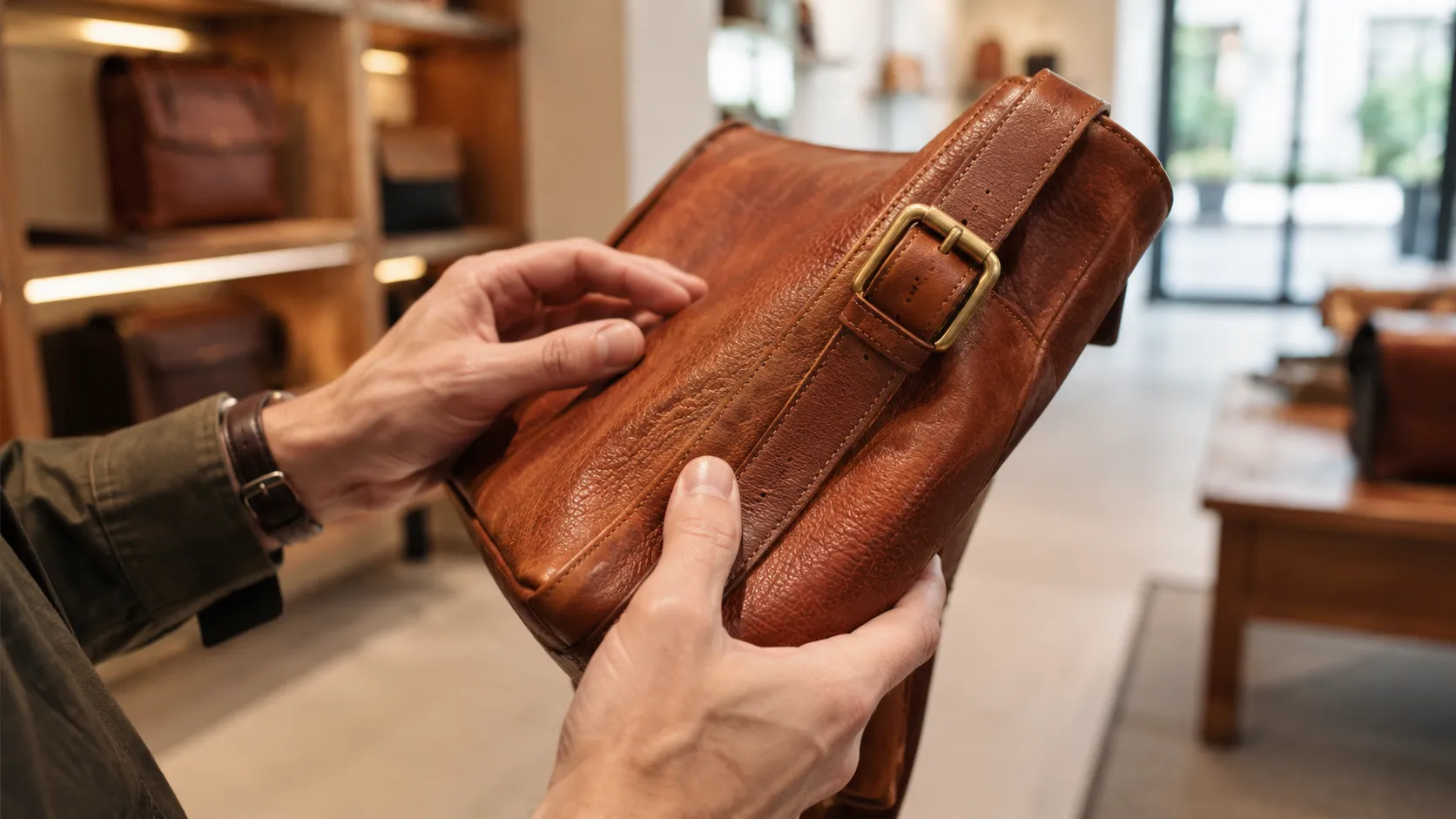
How to check: Look for visible natural grain — subtle pore patterns, slight texture variations, and occasional natural markings. Smell the leather — quality leather has a warm, earthy scent, not a chemical or plastic one. Feel the weight — a quality leather bag has substance. For a complete authentication method, see our real leather identification guide.
Stitching Quality
After the leather, stitching is the clearest quality indicator. Examine it closely.
Signs of quality:
- Straight, even stitch lines with consistent spacing
- Tight tension — no loose loops or gaps
- Matching or complementary thread colour applied cleanly
- Reinforced stitching at stress points (handle attachment, strap junctions, base corners)
- Saddle stitching (two needles, self-locking) on premium bags
Red flags:
- Crooked or uneven lines
- Visible thread ends or fraying
- Skipped stitches
- Single-thread stitching at stress points (fails faster)
The stitching at stress points matters most — where straps meet the body, around zipper ends, and at the base of handles. These areas take the most repeated force. If the stitching is weak here, the bag will eventually fail regardless of the leather quality.
Hardware and Closures
Hardware is the mechanical skeleton of a quality leather bag. Cheap hardware is the single most common failure point.
Quality indicators:
- Material: Solid brass, stainless steel, or zinc alloy. Pick up the bag and feel the hardware weight — quality metal has noticeable heft
- Zippers: Smooth, gliding operation across the full length. Metal teeth are stronger than nylon coils for heavy-use bags
- Buckles: Engage and release cleanly. Tongue sits firmly in holes without wobbling
- Rivets: Flush, firmly seated, no movement when pressed
Red flags:
- Lightweight, plasticky-feeling buckles or clasps
- Zippers that catch, snag, or require force
- Plated hardware that shows a different colour underneath at wear points
- Missing rivets at high-stress junctions
Edge Finishing
Turn the bag over and look at the leather edges. This detail is often overlooked but immediately separates quality from mediocrity.
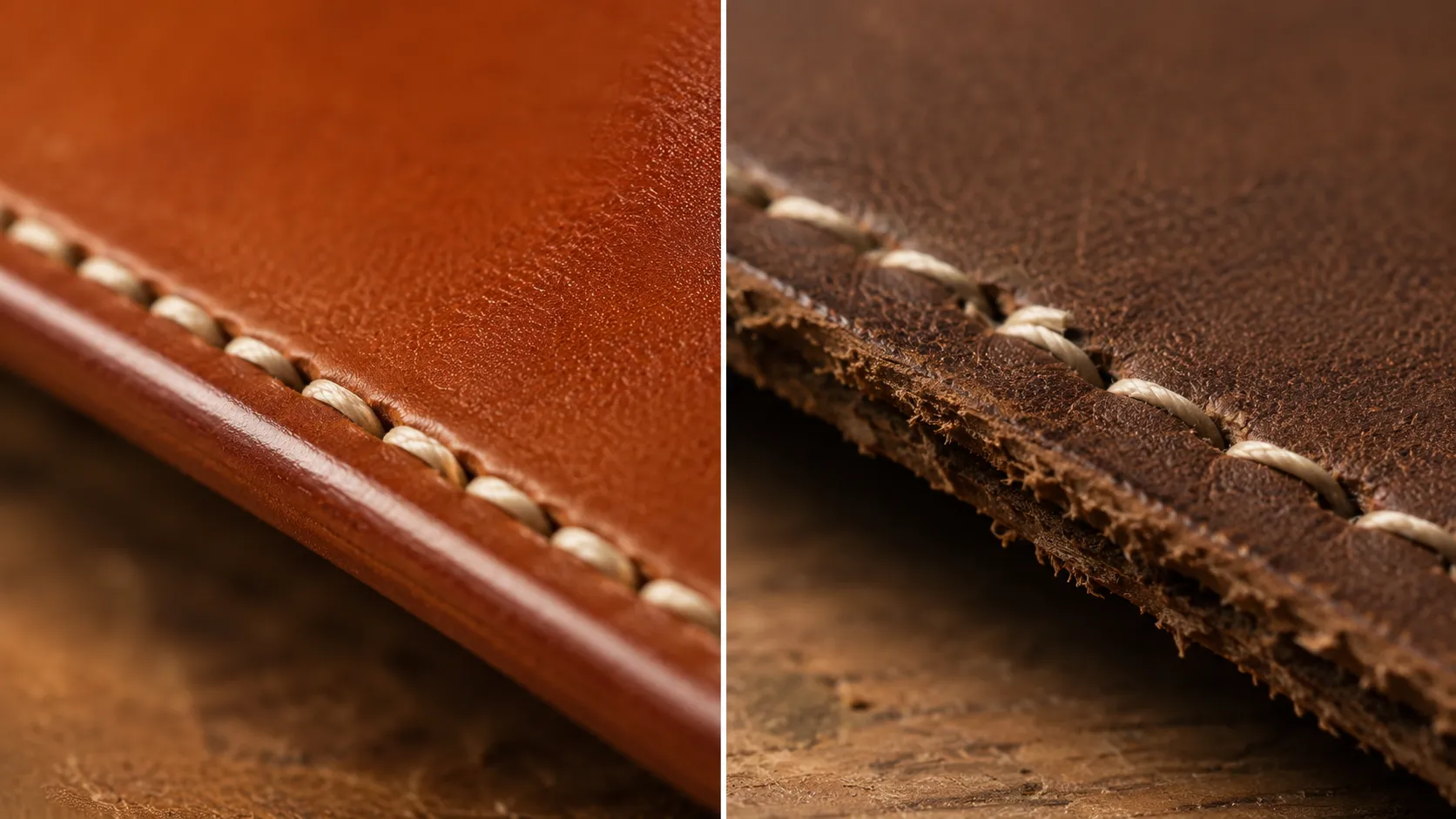
On a quality leather bag: Edges are burnished (heated and polished smooth), painted with edge paint, or folded and stitched. The finished edge is smooth, sealed, and resistant to fraying.
On a cheap bag: Edges are raw, rough, and fibrous — showing unfinished, exposed leather layers. Raw edges absorb moisture, fray over time, and deteriorate rapidly.
Edge finishing takes time and skill, which is why budget manufacturers skip it. Its presence signals that the maker invested in every detail — not just the visible surfaces.
Interior and Lining
Open the bag and examine the inside.
Quality indicators:
- Cotton canvas or heavyweight twill lining — durable and breathable
- Clean, flat lining without bunching or puckering
- Interior stitching is as clean as exterior stitching
- All internal seams are covered or finished
- Functional pockets — zip pockets for valuables, slip pockets for quick access
Red flags:
- Thin synthetic lining that tears easily
- Bunched or glued-in lining with visible adhesive
- Exposed internal seams
- No interior pockets or organisation
Proportions and Structure
A quality leather bag holds its shape. When you set it down — whether full or empty — it should sit upright and maintain a clean silhouette.
Pick the bag up and hold it by the handles or strap. It should feel balanced — not tipping forward or backward. The weight should centre naturally. A bag that sags, collapses, or tilts when carried reveals internal construction shortcuts.
For buying guidance tailored to specific bag types, read our complete buyer’s guide.
The Tanning Method
The tanning method significantly affects a bag’s quality and character.
Vegetable tanned leather uses natural plant tannins and takes weeks to months. It produces a firm, structured leather that develops a rich patina and lasts decades. This is the premium choice for quality leather bags intended for long-term use.
Chrome tanned leather uses industrial salts and takes hours. It is softer and cheaper but does not develop patina and has a shorter functional lifespan.
If the product does not mention its tanning method, it is almost certainly chrome tanned. Quality brands are proud of their vegetable tanning and state it clearly. For a deeper understanding, read how the full leather making process shapes the final product.
The Price Test
A quality leather bag cannot be made cheaply. If the price seems too low for a full grain leather product of that size, something has been compromised.
| Price Range | What to Expect |
|---|---|
| Under $50 | Almost certainly genuine leather, bonded leather, or synthetic. Short lifespan |
| $50–$150 | Mixed quality. Good top grain possible; examine carefully |
| $150–$400 | Quality full grain from artisan or direct-to-consumer brands. Best long-term value |
| $400+ | Premium craftsmanship or designer brands. Excellent quality, brand premium applies |
The cost-per-year equation always favours quality: a $200 bag lasting 15 years costs ~$13/year. A $50 bag lasting 3 years costs ~$17/year — and the frustration of replacement.
Frequently Asked Questions
How can you tell if a leather bag is high quality?
Check five things: the leather grade (full grain is best), the stitching (even, tight, reinforced at stress points), the hardware (solid metal, smooth zippers), the edge finishing (burnished or sealed), and the overall feel (substantial weight, holds its shape). A warm, earthy leather scent confirms real, quality leather.
Is full grain leather the best for bags?
Yes. Full grain leather is the strongest, most durable leather grade available. It uses the outermost layer of the hide with the natural grain intact, providing maximum strength, water resistance, and the ability to develop a rich patina over time.
How long should a quality leather bag last?
A well-made full grain leather bag should last 15 to 30 years with regular care — conditioning every 3 to 6 months and proper storage when not in use. Many quality leather bags remain functional and beautiful for even longer.
What makes handmade leather bags better?
Handmade leather bags receive individual attention at every stage — cutting, stitching, edge finishing, and quality inspection. This results in tighter tolerances, stronger construction, and fewer defects compared to mass-produced alternatives.
Quality Speaks for Itself
A quality leather bag does not need marketing to convince you — the leather, the stitching, and the hardware tell the story the moment you pick it up. Once you know what to look for, the difference between a bag that lasts and one that does not is impossible to miss.
Related posts

Leather Messenger Bag for Women: The Complete Guide
A leather messenger bag for women is the rare bag that carries a laptop to a meeting, a notebook to a café, and your everyday essential...

How to Choose a Leather Laptop Bag: A Buyer’s Guide
Knowing how to choose a leather laptop bag comes down to five decisions: the right bag type, the right size, the right leather grade, r...

Leather Camera Bag: The Complete Buyer’s Guide
A leather camera bag is where photography gear meets everyday style — a way to protect your camera and lens without carrying something ...

Leather Saddle Bag: The Complete Guide
A leather saddle bag is the curved-flap crossbody handbag that has quietly become a modern classic — named for its horseback origins, b...

Leather Hobo Bag: The Complete Guide
A leather hobo bag is the soft, slouchy shoulder bag that never really goes away — the one that molds to your body, swallows your daily...

Oxblood Leather: What Color It Is and How to Style It
Oxblood leather is a deep, dark red leather with rich brown and subtle purple undertones — one of the most versatile and quietly luxuri...